SPARKLE AND GLITTER
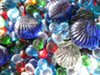
The first thing I remember is being captivated by the sparkle of the world. Windows etched with patterns of frost. Sequins glittering on a party dress. Fake snow on a Christmas card throwing off glints of reds, greens. Real snow, pieces of mica-flecked rock, shimmering in the sun. The tinted night light in the hall and its deep blue glow. Reveries of swirling color.
A recurrent childhood dream – or perhaps a waking vision: I’m walking in a field of tall grass with tufted tops. They start to sway in unison with a rising wind, gently at first, and then with more emphatic motion. Soon the tufts on top, the seeds, detach and turn to powdered granules of color. They shimmer and swirl, glittering, colors blending, churning. Multicolored. My favorite color. Like floating clouds, the colors mingle, float, blend. Until they are one color, a floating field of turquoise that enfolds me.
I had forgotten my feeling about the world’s sparkle until after I had already received my MA and had begun teaching art history. I wasn’t really thinking about it either, many years later when I began to set up my altar to glitter – sea glass, prisms, glass candies – on a circular glass table illuminated by the path of the sun.
But given my visceral pleasure in the world’s visual array, it’s no wonder that I began to work in stained glass. I love to play with glass. I love to look at it. To hold sheets of it up to the light and watch the colors come alive. To put together shards and cuttings. To caress and arrange glass jewels, globs, bulls-eyes, bevels. To use glass as a means of visual thinking. And as a way of becoming wrapped, submerged, enveloped, in the glitter of the world.
I took my first course in stained glass the semester before I started back at graduate school to get my Ph.D . The next one I took was 26 years, and several lifetimes, later. Without premeditation, my glass works have fallen into several series that are inspired by art that I love.
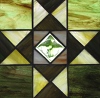
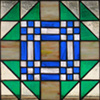
My very first piece was based on a quilt pattern, although at the time I didn’t really realize the connection (Nine Patch #1). My second panel was an abstract landscape – Fall. Both these themes were picked up later when I returned to glass making.
 |
 |
 |
 |
 |
 |
 |
 |
 |
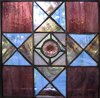
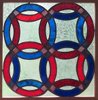
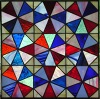
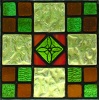
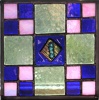
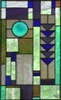
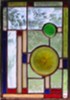
I continued exploring the idea of making glass quilts and have made a number of panels based on quilt patterns. In most I use a single square as the basis for the glass panel, but I decided to make Kaleidoscope out of nine glass squares in order to set up the intense optical illusion that occurs in some American quilts.
 |
 |
 |
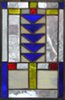 |
The first panel I made after returning to glass making was a variation on a Prairie style pattern. I have continued to make works inspired by that idiom, including a loose interpretation of a window in Frank Lloyd Wright’s Coonley House, and a commission for a private client.
 |
 |
 |
 |
 |
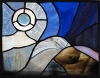 |
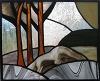
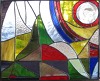
Not long after my return to glass, I revisited the theme of the abstact landscape. To date I have completed Spring and Winter, which along with the earlier Fall and the projected Summer form a suite of panels embodying the Four Seasons.
 |
 |
 |
 |
 |
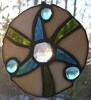 |
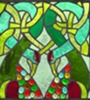
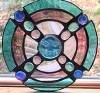
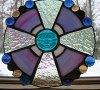
I have also made several works based on Celtic motifs, including some smaller roundels and a head derived from a finial of an intitial in The Book of Durrow (7th century, CE).
 |
 |
 |
 |
 |
 |
 |
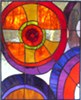
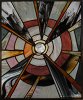
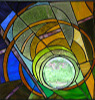
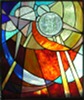
At the beginning of the last century artists created a dynamic visual language to express the interpenetration of light, space, and motion. Even now, a century later, the idiom has yet to be fully accepted or understood. My largest works – along with some smaller panels – are based on constructivist paintings of the 20th century by such artists as Sonia Delaunay, Robert Delaunay, and Liubov Popova.
 Mara Witzling